Table of Contents
Executive Summary
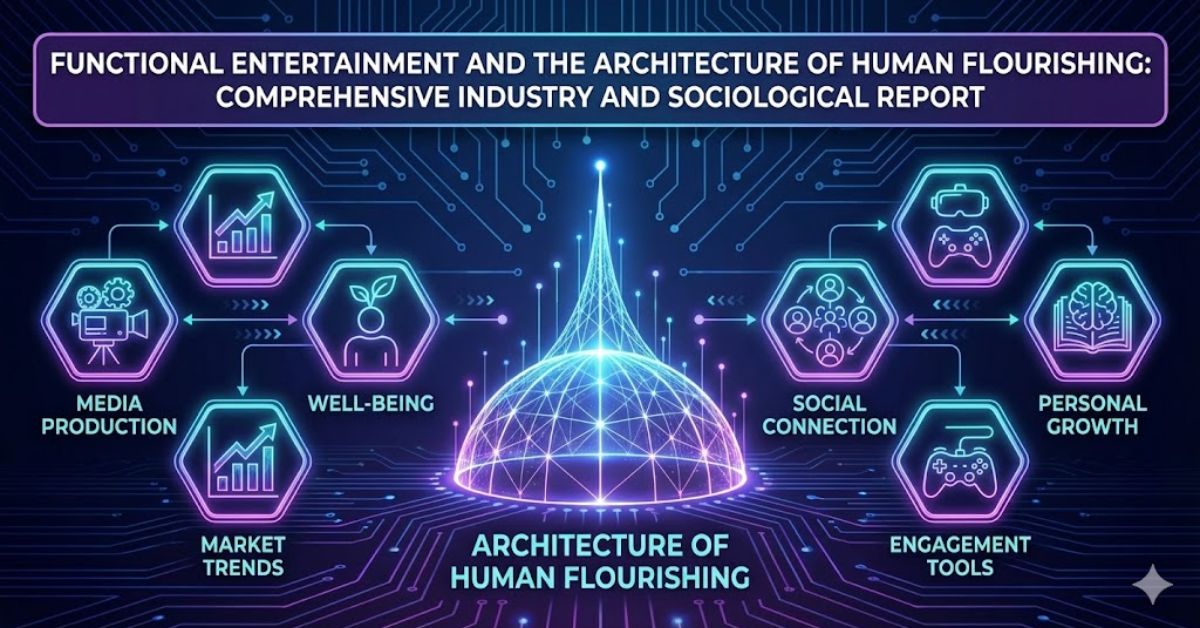
The fiscal and cultural landscape of 2025 represents a definitive schism in the history of the global Media and Entertainment (M&E) industry. We have transitioned from the “Attention Economy” characterized by the aggressive monetization of passive screen time to the “Intention Economy,” where value is derived from functional utility, cognitive restoration, and the fostering of genuine human connection. This report, synthesized from exhaustive 2025 industry data, academic research, and market analysis, posits that entertainment has evolved into a critical utility for human flourishing.
Projected to reach a market capitalization of $3.5 trillion by 2029, the industry is undergoing a metamorphosis driven by three converging crises: a global mental health epidemic, the fracturing of social infrastructure, and the ecological imperative of climate change.1 In response, a new genre of “Functional Entertainment” has emerged. This category encompasses video games cleared as therapeutic devices, Virtual Reality (VR) environments used for exposure therapy, and social platforms re-engineered to combat loneliness rather than exacerbate it.
This document serves as a universal roadmap for navigating this new terrain. It provides a granular analysis of how specific technologies from Brain-Computer Interfaces (BCI) to generative AI are being deployed to optimize human cognition and emotional well-being. By examining the intersection of economic forces, technological breakthroughs, and sociological shifts, this report demonstrates how the entertainment sector is uniquely positioned to solve the very problems it once helped create.
1. The Macro-Economic Landscape of 2025
1.1 The Convergence of Content and Capital
The economic trajectory of the media and entertainment sector in 2025 is defined by convergence and capital intensification. The boundaries that once clearly delineated film, television, music, gaming, and sports have largely evaporated, replaced by a nebulous ecosystem where Intellectual Property (IP) flows fluidly across platforms.4 This convergence is not merely aesthetic but structural, driven by the economic necessity of leveraging content across multiple revenue streams to justify the skyrocketing costs of production.
As we look toward 2029, the industry is on track to unlock an additional $577 billion in new revenues compared to 2024 levels.1 However, this growth is not evenly distributed. The traditional pillars of the industry cable television and linear broadcasting are eroding at an accelerated pace, yielding ground to a complex matrix of Over-The-Top (OTT) streaming, immersive gaming, and user-generated social video. The US OTT market alone is projected to grow at a Compound Annual Growth Rate (CAGR) of 5.9%, swelling from $61.9 billion in 2024 to $112.7 billion by 2029.1
This growth, however, comes with significant friction. The “cost of content” continues to rise for the largest studios, driven by the need for premium, franchise-grade productions that can compete with the endless deluge of free, user-generated content on social platforms.5 Simultaneously, the capital intensity required to support the infrastructure of this digital ecosystem specifically data centers and Artificial Intelligence (AI) capabilities looms large over the balance sheets of hyperscalers and platform holders.5
1.2 The Shift in Value Propositions
The fundamental value proposition of entertainment has shifted. In previous decades, the primary metric of success was “time spent.” In 2025, while engagement remains crucial, the quality of that engagement has become the differentiator. Consumers, besieged by inflation and “digital fatigue,” are becoming far more discerning with their discretionary income and time.6
Data from 2025 indicates that the “subscription fatigue” phenomenon is real, pushing the market toward hybrid monetization models. We are seeing a consolidation where video entertainment is increasingly shaped by a few leading Subscription Video-On-Demand (SVOD) services that have successfully integrated ad-supported tiers.5 These platforms are not just competing with each other; they are competing with the “free” utility of social video platforms, which now command over half of all US advertising spending.7
The economic implication is clear: to survive, entertainment products must offer more than distraction. They must offer function. This is why the gaming sector, with its inherent interactivity and social connectivity, has captured a massive share of entertainment time and revenue, particularly among younger generations.5 Gaming is no longer a parallel vertical; it is the “center of gravity” for the new media economy, converging with video entertainment to create immersive, interactive experiences that justify their cost through high engagement and social utility.5
Table 1: Global Media & Entertainment Economic Projections (2025-2033)
| Market Segment | Projected Value | Growth Trajectory (CAGR) | Key Economic Driver | Source |
| Global M&E Total | $3.5 Trillion (by 2029) | 3.7% (2025-2029) | Digital convergence & functional media | 1 |
| Virtual Reality (VR) | $382.87 Billion (by 2033) | 27.3% | Therapeutic & Enterprise applications | 10 |
| US OTT Video | $112.7 Billion (by 2029) | 5.9% | Specialized streaming & ad-tiers | 1 |
| Gaming | ~$250 Billion (2025) | N/A (Largest Sector) | Social connectivity & interactive IP | 11 |
| Mobile Ad Spend | >50% of Total Ad Spend | N/A | Algorithmic targeting on social platforms | 7 |
1.3 The “Immersive Curious” Consumer
A critical demographic shift identified in the “2025 Immersive Entertainment & Culture Industry Report” is the rise of the “immersive curious” consumer.12 Contrary to the narrative that digital technology breeds isolation, this data suggests a profound hunger for shared, physical, and spatially rich experiences. A staggering 73% of surveyed audience members expressed a willingness to travel for high-quality immersive experiences.12
This willingness to travel and pay a premium for “presence” suggests that the “Experience Economy” has fully recovered and evolved. It is no longer enough to watch a movie; audiences want to inhabit the world of the film. This demand is driving investment in Location-Based Entertainment (LBE), such as Sony’s Wonderverse in Chicago, which blends physical dining and social spaces with digital IP.13 The economic lesson here is that while digital distribution scales, physical immersion commands a premium, validating the “hybrid” future of entertainment where digital and physical realities are mutually reinforcing.
2. The Architecture of Immersive Reality: VR as a Utility
2.1 The Maturation of Hardware
By 2025, Virtual Reality (VR) has successfully crossed the chasm from early adopter novelty to mass-market utility. The hardware landscape is dominated by devices that prioritize accessibility, comfort, and mixed reality capabilities. The Meta Quest 3S, priced at an accessible $299, has become the standard-bearer for entry-level VR, featuring color pass-through technology that allows users to blend virtual objects with their physical surroundings.14
At the high end, the Apple Vision Pro and HTC Vive Focus Vision cater to enterprise and therapeutic markets, offering the fidelity required for medical applications and high-level cognitive training.14 This bifurcation of the hardware market accessible consumer units vs. high-fidelity professional units has created a robust ecosystem where software developers can target specific user needs, from casual relaxation to intensive trauma therapy.
The dominance of “Hardware Components” in the global VR market share indicates that innovation is still heavily focused on the delivery mechanism making headsets lighter, displays crisper, and tracking more accurate.10 These improvements are not merely technical; they are the prerequisite for therapeutic efficacy. For VR to heal, the brain must be convinced of the reality of the simulation, a state known as “presence.” The 2025 hardware generation is the first to reliably achieve this state without the motion sickness or pixelation that plagued earlier iterations.
2.2 Virtual Reality Exposure Therapy (VRET)
The most profound application of this matured hardware is in the field of mental health, specifically Virtual Reality Exposure Therapy (VRET). In 2025, VRET is widely recognized as a gold-standard intervention for a variety of anxiety disorders, phobias, and Post-Traumatic Stress Disorder (PTSD).17
The mechanism of VRET is rooted in the psychological principle of systematic desensitization. By exposing a patient to a feared stimulus in a controlled, gradual manner, the brain learns to decouple the stimulus from the fear response. VR allows for a level of control that is impossible in the real world. A therapist can dial up the intensity of a “fear of flying” simulation from a calm takeoff to severe turbulence in real-time, based on the patient’s physiological feedback.18
Key Therapeutic Applications in 2025:
- PTSD Recovery: For veterans and survivors of accidents, VR can recreate specific traumatic scenarios (e.g., a convoy in a desert or a car crash) to facilitate emotional processing in a safe environment.19
- Social Anxiety: Simulations allow users to practice public speaking or social mingling in virtual rooms populated by avatars, providing a low-stakes training ground for social skills.18
- Phobia Management: Specialized applications treat specific phobias such as arachnophobia (fear of spiders) or acrophobia (fear of heights) with high efficacy rates.20
The accessibility of this technology means that VRET is no longer confined to specialized clinics. With telehealth platforms now integrating VR, patients can undergo exposure therapy from their living rooms, guided remotely by clinicians.21 This democratization of advanced therapy is a key pillar of the “Functional Entertainment” movement.
2.3 VR for Senior Care and “Silver Gamers”
One of the most heartwarming and impactful trends of 2025 is the explosion of VR usage among the elderly. As mobility declines, the world of the senior citizen often shrinks to the four walls of their room. VR reopens the world. Platforms like Rendever have built their entire business model on shared experiences for seniors, allowing them to revisit their childhood homes, attend virtual weddings, or explore bucket-list destinations like the Grand Canyon.22
These experiences are not just diversions; they are potent interventions against the crushing isolation that often accompanies aging. Research shows that VR experiences can significantly reduce feelings of isolation and improve overall well-being in older adults.24
- Cognitive Stimulation: VR games that involve puzzles or virtual travel provide gentle cognitive exercise, helping to maintain mental acuity and potentially delaying the onset of dementia.25
- Reminiscence Therapy: By visiting locations from their past (via Google Earth VR integration), seniors can trigger deep memories and emotional connections, a technique known as reminiscence therapy which is highly beneficial for emotional health.23
- Physical Activation: Rhythm games and virtual sports encourage light physical activity, helping to maintain range of motion and coordination in a low-impact environment.24
3. Ludology as Medicine: The Rise of Therapeutic Gaming
3.1 The “Games for Change” Movement
By 2025, the notion that video games are merely “toys” has been thoroughly dismantled. The “Games for Change” movement, which advocates for the use of games and immersive media for social impact, has moved from the fringe to the mainstream. The 2025 awards slate highlights a diverse array of titles that tackle complex societal and personal issues, from environmental conservation to mental health management.26
The winner of the “Best in Health & Wellness” award, Vampire Therapist, serves as a prime example of this trend. Developed by Little Bat Games, this title uses the narrative framework of a vampire seeking redemption to teach players real-world Cognitive Behavioral Therapy (CBT) techniques.27
Deep Dive: Vampire Therapist and CBT
Vampire Therapist represents a sophisticated integration of clinical psychology and game design. The player takes on the role of a therapist guiding immortal beings through centuries of accumulated trauma and cognitive distortions.
- Mechanism: The game mechanics require the player to identify “cognitive distortions” such as catastrophizing, black-and-white thinking, or emotional reasoning in the dialogue of their patients.
- Impact: By externalizing these internal psychological processes and applying them to fictional characters, players learn to recognize these patterns in their own thinking. Reviews praise the game for its respectful handling of mental health, noting that it “doesn’t belittle any of the thoughts of the clients” and successfully destigmatizes the therapeutic process.28
- Outcome: Players walk away with a vocabulary for their own emotions and a toolkit for managing their own mental health, all acquired through “play” rather than didactic instruction.
3.2 The Philosophical Engine: Indika
If Vampire Therapist is the clinic, Indika is the confessional. Nominated for “Game of the Year” and winner of “Best Narrative,” Indika explores the psychological landscape of religious trauma and existential doubt.26
Set in a surreal, alternative 19th-century Russia, the game follows a nun who is tormented by a voice that may be the devil or simply her own repressed critical thinking.30
- Procedural Rhetoric: The game uses its mechanics to enforce feelings of futility and struggle, forcing the player to physically enact the protagonist’s spiritual burden. This is “functional” entertainment in a different sense: it functions as a mirror for the soul, allowing players to explore complex themes of faith and authority safely.31
- Cultural Significance: Analysts note that Indika creates a space for the exploration of “spiritual health,” a dimension of well-being often overlooked in the secular focus of modern psychology.32 By engaging with these themes, the game provides a cathartic outlet for players grappling with similar issues in their own lives.
3.3 The “Cozy Game” Revolution
At the other end of the emotional spectrum lies the “Cozy Game” phenomenon. In a world defined by high-stress news cycles and economic uncertainty, games that offer low-stakes, high-reward loops have become a form of digital self-medication.
Titles like Stardew Valley, Tiny Pixel Farm, and Two Dots are cited by developers and players alike as essential tools for “therapeutic farming” and relaxation.33
- Restorative Media: These games function on the principle of “Restoration Theory.” They provide a “soft fascination” environments that are engaging enough to distract from worry but not so demanding that they cause fatigue.
- Flow States: The simple, repetitive actions (harvesting crops, connecting dots) induce a “flow state,” a psychological zone of immersion that blocks out negative rumination.34
- Accessibility: Unlike high-fidelity AAA games, these mobile-friendly titles are accessible to anyone with a smartphone, making “digital tranquility” a universally available resource.35
3.4 Serious Games for ADHD
The “Serious Games” sector games designed primarily for a purpose other than pure entertainment has seen significant traction in the treatment of ADHD. A systematic review of games released up to 2025 identifies that game elements like the “go/no-go” task and “continuous performance” challenges are effective in training impulse control and sustained attention.37
Critically, nearly one-fifth of these games now include theta/beta ratio neurofeedback, directly integrating physiological data into the gameplay loop.37 This represents a fusion of gaming and medical technology, where the controller is not just a joystick, but the player’s own brainwaves.
4. The Neuro-Interface: BCI and Cognitive Optimization
4.1 The Era of Consumer Neurofeedback
In 2025, Brain-Computer Interface (BCI) technology has migrated from the research lab to the living room. Devices like the Muse S, BrainBit, and Neurosity Crown have made electroencephalography (EEG) accessible to the average consumer.38 These devices are marketed not as medical equipment, but as high-end wearables for “brain training” and “peak performance.”
Key Market Leaders in 2025:
- Muse S ($399): Focuses on meditation and sleep. It uses EEG sensors to translate brain activity into weather sounds calm mind, calm weather. This immediate auditory feedback teaches users how to self-regulate their mental state.38
- Neurosity Crown ($$$$): Positioned for the “productivity” market. It claims to help users achieve and maintain “flow states” for deep work, tracking focus metrics in real-time.39
- BrainBit: Offers a flexible headband that integrates with various third-party apps, allowing for “neuro-gaming” where game difficulty adapts to the player’s stress or focus levels.40
4.2 Neuro-Gaming Mechanics
The integration of BCI with gaming (“Neuro-Gaming”) creates a feedback loop that rewards the brain for healthy patterns.
- Mechanism: In a typical neuro-game like Forest Defense (BrainBit), the player might need to “heal” a forest. The speed of healing is directly tied to the user’s ability to generate specific brainwaves (e.g., increasing Alpha waves for relaxation or Beta waves for focus).40
- Implication: This turns mental regulation into a trainable skill. Just as a player learns to aim better with a mouse, they learn to “focus better” with their mind. This concept of “neuroplasticity on demand” is the core promise of the sector.
4.3 Efficacy and “Digital-Physical Crossover”
The question remains: does this training transfer to real life? 2025 research suggests yes. A landmark study from the University of Bradford found evidence of “digital-physical crossover.” Novices who played video archery games actually improved their real-life archery skills, and vice versa.42 This suggests that the neural pathways forged in the digital realm have tangible physical counterparts.
Furthermore, longitudinal studies on platforms like Lumosity (which has over 100 million users) continue to show that consistent training can improve working memory, problem-solving, and information processing speed.43
4.4 The Physiology of Screen Time
One of the most significant findings of 2025 is the differentiation between types of screen time. A world-first study led by Swinburne University used functional near-infrared spectroscopy (fNIRS) to map brain activity during different screen activities.44
- The Findings: Social media use was associated with decreased focus and signs of physiological stress (increased oxygenated hemoglobin). In contrast, TV viewing and Gaming were associated with increased focus and better mood regulation.
- The Takeaway: Not all pixels are created equal. Interactive (gaming) and narrative (TV) experiences appear to be neuro-protective or restorative, while the fragmented, comparative nature of social media feeds is the primary driver of “screen fatigue” and cognitive scatter.44
5. The Social Dilemma 2.0: Connectivity vs. Isolation
5.1 The Loneliness Epidemic
Despite or perhaps because of hyper-connectivity, the world in 2025 faces a “Loneliness Epidemic” of staggering proportions. The US Surgeon General has issued an advisory highlighting the “Healing Effects of Social Connection,” framing loneliness as a public health priority comparable to obesity or substance abuse.45
Research from Oregon State University explicitly links high-frequency social media use to increased loneliness. Users in the top quartile of social media frequency are more than twice as likely to report feeling isolated compared to those in the bottom quartile.2 The mechanism is clear: social media provides “parasocial” snacks that momentarily distract from hunger but fail to provide the nutritional sustenance of genuine connection.46
5.2 “Anti-Loneliness” Platforms
In response to this crisis, a new wave of digital platforms has emerged, explicitly designed to foster depth and connection rather than engagement and clicks.
- Tribal: This app markets itself as the “opposite of swipe culture.” It uses a “72-hour photo blur” feature, forcing users to converse and connect on values and personality before seeing each other’s physical appearance. It is a direct reaction against the superficiality of previous dating/friendship apps.47
- 222: Using AI, this platform facilitates real-world meetups based on shared interests. It acts as a digital bridge to physical community, using technology to get people off their phones and into the same room.48
- Lonely App: Recognizing the stigma of loneliness, this platform provides an anonymous space for users to express their feelings and find solidarity. It validates the emotion of loneliness, removing the shame that often prevents people from seeking help.49
5.3 Gaming as the New “Third Place”
While social media fractures, gaming connects. The Entertainment Software Association (ESA) reports that 64% of players feel video games help them feel less isolated.50 In a world where physical “third places” (community centers, parks, pubs) are declining or becoming expensive, online game worlds have stepped in to fill the void.
- Cooperative Play: Unlike the passive consumption of a feed, multiplayer games require active cooperation. Defeating a raid boss or building a base in Minecraft requires communication, trust, and shared goal-setting the building blocks of friendship.
- Corporate Team Building: This dynamic is being harnessed by the corporate world. Virtual team-building games like “Coworker Feud” and “Team Trivia” are now standard tools for maintaining morale in remote-first companies.51 These games provide a structured social lubricant that replaces the “water cooler” moments of the physical office.
6. Global Equity and Educational Gamification
6.1 The EdTech Boom in the Global South
Functional entertainment is playing a transformative role in the developing world. The global K-12 education technology market is projected to reach $230 billion by 2034, with the fastest growth occurring in Africa and the Asia Pacific region.52 This growth is driven by the ubiquity of mobile devices, which allow high-quality educational content to leapfrog the limitations of physical infrastructure.
6.2 Preserving Culture Through Gamification
In Africa, gamification is being used not just for STEM skills, but for cultural preservation.
- Language Learning: Apps like NKENNE and Angula are digitizing African language education. NKENNE offers lessons in over a dozen languages (including Yoruba and Somali), while Angula focuses on Southern African languages like isiZulu.53 By gamifying these lessons, these platforms make language learning addictive and accessible, countering the linguistic erosion caused by globalization.
- Cultural Narratives: Dialogue Africa combines language learning with cultural insights from Ghana, Nigeria, and Kenya, ensuring that the “software” of culture stories, idioms, history is preserved alongside the “hardware” of vocabulary.53
6.3 The Efficacy of Stealth Learning
The success of these platforms relies on “stealth learning” the integration of educational content so seamless that the user perceives the activity primarily as play. The UNICEF Innocenti research center has validated this approach, finding that “safe and inclusive digital play can have a profoundly positive impact on children’s lives,” meeting their psychological needs for competence, autonomy, and relatedness.54
Award-winning titles like Tablecraft (Best in Learning, Games for Change 2025) demonstrate that games can teach complex systems thinking and chemistry without feeling like a textbook.26 This shift from “Edutainment” (which was often boring) to “Learning Games” (which are genuinely fun) is the key differentiator of the 2025 market.
7. The Green Screen: Sustainability in Entertainment
7.1 The Ecological Footprint of Digital Media
As the digital world expands, its physical footprint in terms of energy consumption and e-waste becomes a critical concern. In 2025, the industry has pivoted toward “Sustainability-First Production”.55 This is not just about public relations; it is about survival. Regulatory pressures and consumer demand are forcing companies to account for every watt of power used in data centers and on user devices.
7.2 “Green Management” Strategies
Major industry players have rolled out aggressive sustainability frameworks.
- Sony’s Road to Zero: Sony’s “Green Management 2025” plan targets a zero environmental footprint. This involves engaging the entire supply chain to reduce Greenhouse Gas (GHG) emissions and using their entertainment content to educate their 2 billion users about the UN Sustainable Development Goals (SDGs).3
- Microsoft’s Carbon Aware Gaming: The “Xbox Sustainability Toolkit” represents a paradigm shift in software engineering. It allows developers to measure the energy intensity of their code. By optimizing game engines to require less processing power, and by implementing “energy saver” modes on consoles, Xbox has prevented over 1.2 million metric tons of CO2e emissions.56 This proves that “green coding” is a viable strategy for climate action.
7.3 Sustainable Live Events
The physical side of entertainment is also transforming. The “2025 Immersive Entertainment & Culture Industry Report” highlights how venues are integrating sustainability into their architecture. The Paris Aquatics Centre, built for the Olympics and continuing as a venue, features 5,000 square meters of photovoltaic panels and seats made from recycled plastic.4 Similarly, festivals like Lollapalooza have transitioned to hybrid battery systems to eliminate the noise and pollution of diesel generators.4
8. The Economic Engine: Advertising, Creators, and AI
8.1 The Dominance of Social Video
In the battle for attention, social video has won. By 2025, social platforms account for more than half of all US advertising spending.7 These platforms have become the “new center of gravity” for the media ecosystem, capturing the time and loyalty of Gen Z and Millennial audiences.8
This shift is forcing traditional media to adapt. Studios are now partnering with “creators” individuals who command massive, loyal followings to market their content. The “parasocial” bond between a creator and their audience is often stronger than the bond between a viewer and a TV star, making creators the most efficient vehicle for marketing in the 2025 landscape.46
8.2 The Double-Edged Sword of AI
Artificial Intelligence permeates every layer of the 2025 entertainment stack.
- Production: Generative AI is being used to automate voiceovers, script drafting, and even background animation. This lowers the barrier to entry, allowing smaller studios to produce “blockbuster” quality content.55
- Recommendation: AI algorithms now curate the vast majority of content consumed by users. While this increases engagement, it also risks creating “filter bubbles” that limit exposure to diverse viewpoints.7
- Authenticity: The proliferation of AI-generated content has created a “trust deficit.” Audiences are increasingly skeptical of digital content, driving a premium for “authentic” human connection and live experiences a trend that fuels the growth of the immersive and experiential sectors discussed in Chapter 2.57
9. Future Horizons: 2029 and Beyond
9.1 The Trajectory of Human Flourishing
As we look toward 2030, the “Intention Economy” will likely mature into an “Impact Economy,” where media products are measured by their verifiable contribution to human flourishing. The OECD’s framework on “Education for Human Flourishing” suggests that future systems will prioritize the development of agency, meaning, and security goals that functional entertainment is uniquely suited to support.58
9.2 The Next Five Years
- Hardware: VR headsets will become lighter and indistinguishable from standard eyewear, further accelerating the adoption of AR/MR applications.
- Software: “Prescription Gaming” will become a standard category in health insurance plans, with doctors prescribing specific game titles for anxiety, ADHD, or rehabilitation.
- Society: The “Loneliness Epidemic” will likely peak and begin to decline as the “anti-loneliness” tech sector matures and digital literacy education catches up to the technology, teaching users how to use these tools for connection rather than comparison.
9.3 Conclusion
The research of 2025 presents a clear narrative: we have the tools to heal ourselves. The convergence of neuroscience, game design, and social theory has produced a powerful new arsenal for human well-being. The challenge now lies not in innovation, but in adoption. For the individual, the task is to curate a media diet that nourishes rather than depletes. For the industry, the task is to build products that respect the sanctity of human attention and contribute to the resilience of the human spirit. In this new era, entertainment is not an escape from reality; it is the toolkit we use to build a better one.
10. Data & Statistical Appendix
Table 2: Functional Entertainment Application Matrix (2025)
| User Goal | Recommended Tool/Platform | Mechanism of Action | Evidence Base | Source |
| Manage Anxiety | Vampire Therapist / Stardew Valley | CBT Skills / Flow State | Games for Change Winner / Restoration Theory | 26 |
| Improve Focus | Neurosity Crown / BrainBit | Neurofeedback (Beta training) | fNIRS Studies / EEG Data | 39 |
| Combat Loneliness | Tribal / 222 / Rendever (Seniors) | Value-matching / Shared VR | Surgeon General Advisory / OSU Study | 22 |
| Treat Phobias | Meta Quest 3S (VRET Apps) | Systematic Desensitization | Clinical VRET Studies | 17 |
| Cultural Learning | NKENNE / Angula | Gamified Linguistics | Research & Markets EdTech Report | 52 |
Table 3: Environmental Impact of Gaming Initiatives
| Initiative | Metric of Success | Mechanism | Source |
| Xbox Sustainability Toolkit | 1.2M metric tons CO2e prevented | Code optimization & energy saver modes | 56 |
| Sony Green Management | Zero Environmental Footprint (Target) | Supply chain engagement & renewable energy | 3 |
| Paris Aquatics Centre | 5,000 sqm Solar Panels | Sustainable architecture & recycled materials | 4 |
Works cited
- US Edition: Global Entertainment & Media Outlook 2025-2029 – PwC,https://www.pwc.com/us/en/industries/tmt/library/global-entertainment-media-outlook.html
- Loneliness in U.S. adults linked with amount, frequency of social media use,https://health.oregonstate.edu/news-and-stories/2025-10/loneliness-us-adults-linked-amount-frequency-social-media-use
- Sustainability Report 2025 Environment – Sony,https://www.sony.com/en/SonyInfo/csr/library/reports/SustainabilityReport2025_environment_E.pdf
- AI in entertainment – 2025 TECH TRENDS REPORT • 18TH EDITION,https://ftsg.com/wp-content/uploads/2025/03/Entertainment_FINAL_LINKED.pdf
- Media and entertainment outlook | Deloitte Insights,https://www.deloitte.com/us/en/insights/industry/technology/technology-media-telecom-outlooks/2025-media-entertainment-outlook.html
- Uncovering Emotional and Identity-Driven Dimensions of Entertainment Consumption in a Transitional Digital Culture – MDPI,https://www.mdpi.com/2076-328X/15/8/1049
- How social and streaming are redefining video entertainment – Digital Content Next,https://digitalcontentnext.org/blog/2025/04/08/how-social-and-streaming-are-redefining-video-entertainment/
- 2025 Digital Media Trends: Social platforms are becoming a dominant force in media and entertainment – Deloitte,https://www.deloitte.com/us/en/insights/industry/technology/digital-media-trends-consumption-habits-survey/2025.html
- Perspectives: Global E&M Outlook 2025–2029 – PwC,https://www.pwc.com/gx/en/issues/business-model-reinvention/outlook/insights-and-perspectives.html
- Virtual Reality Growth Trends Report 2025: Global Market to – GlobeNewswire,https://www.globenewswire.com/news-release/2025/03/18/3044525/28124/en/Virtual-Reality-Growth-Trends-Report-2025-Global-Market-to-Grow-by-339-29-Billion-by-2033-Driven-by-Rising-Applications-in-Surgery-Immersive-Entertainment-Simulation-Developments-P.html
- Entertainment Industry Report – 2025 – Platinum Ridge Management,https://platinumridgemanagement.com/entertainment-industry-report-2025/
- The 2025 Immersive Entertainment & Culture Industry Report – Gensler,https://www.gensler.com/gri/immersive-industry-report-2025
- Top 11 immersive trends in the attractions industry for 2025 | blooloop,https://blooloop.com/immersive/in-depth/immersive-trends-2025/
- Best VR Headsets of 2025: My Favorite Hardware Right Now – CNET,https://www.cnet.com/tech/gaming/best-vr-headset/
- The Best VR Headsets We’ve Tested for 2025 – PCMag,https://www.pcmag.com/picks/the-best-vr-headsets
- The Best VR Headsets 2025: The Future of Immersive Tech – YORD Studio,https://yordstudio.com/best-vr-headsets-2025/
- Virtual Reality: Challenges and Perspectives in Mental Health – PMC – PubMed Central,https://pmc.ncbi.nlm.nih.gov/articles/PMC12593772/
- Transforming Mental Health with Virtual Reality Therapy,https://www.ochealthpsych.com/transforming-mental-health-with-virtual-reality-therapy/
- Top 10 Use Cases of Virtual Reality in Mental Health – Appinventiv,https://appinventiv.com/blog/virtual-reality-in-mental-health/
- Virtual Reality Revolutionizes the Treatment of Mental Health Disorders,https://www.library.rochester.edu/about/news/virtual-reality-revolutionizes-treatment-mental-health-disorders
- Mental health clients’ perspectives on telehealth-based virtual reality therapy – Frontiers,https://www.frontiersin.org/journals/virtual-reality/articles/10.3389/frvir.2025.1595326/full
- Rendever: Virtual Reality for Seniors,https://www.rendever.com/
- Virtual Reality Vacations for Seniors,https://caringseniorservice.com/blog/virtual-reality-vacations-for-seniors/
- Best VR Games for Seniors on Meta Quest 2 & 3 – VRDB Blog,https://vrdb.app/blog/2025-02-05-vr-for-seniors
- Virtual Reality for Seniors: Enhancing Life Through Technology – SeniorTalk,https://www.senior-talk.com/blog/virtual-reality-for-seniors-enhancing-life-through-technology
- Games for Change 2025 Awards winners unveiled | GamesIndustry.biz,https://www.gamesindustry.biz/games-for-change-2025-awards-winners-unveiled
- Vampire Therapist on Steam,https://store.steampowered.com/app/2481020/Vampire_Therapist/
- Vampire Therapist | Steam Deck Review for The Gaming Outsider,https://thegamingoutsider.com/2024/08/12/vampire-therapist-steam-deck-review/awhite/
- All The Nominees & Winners From The 2025 Games For Change Awards,https://themagicrain.com/2025/06/all-the-nominees-winners-from-the-2025-games-for-change-awards/
- Indika Review – The Devil Makes Three – GameSpot,https://www.gamespot.com/reviews/indika-review-the-devil-makes-three/1900-6418221/
- Indika Review | Hey Poor Player,https://www.heypoorplayer.com/2024/05/02/indika-review-pc/
- Indika is a thoughtful and earnest examination of religious belief and guilt | Mega Bears Fan,http://www.megabearsfan.net/post/2024/09/07/Indika-game-review.aspx
- 6 Best Casual Games Apps for Fun and Relaxation in 2025 – Software House,https://softwarehouse.au/blog/6-best-casual-games-apps-for-fun-and-relaxation-in-2025/
- Improving Relaxation and Mindfulness: Top Mobile Games to Unwind – Revinfotech,https://www.revinfotech.com/blog/improving-relaxation-and-mindfulness-top-mobile-games-to-unwind/
- Future and New Trends of Entertainment Apps 2025 – Touchlane,https://touchlane.com/trending-entertainment-apps-whats-next-in-2025/
- 10 Calming Mobile Games & Apps to Help You Keep Your Cool – Apartment Therapy,https://www.apartmenttherapy.com/calming-mobile-games-36749956
- A systematic review and content analysis of serious video games for children with ADHD,https://pmc.ncbi.nlm.nih.gov/articles/PMC12536224/
- Top Neurofeedback Devices of 2025: Enhance Your Mental Health and Focus at Home,https://www.narbis.com/blog/top-ten-neurofeedback-devices/
- Top 7 brain training devices 2025: Muse, Mendi & more,https://choosemuse.com/blogs/news/top-brain-training-devices-2025
- Professional Neurofeedback Solutions for Practitioners – BrainBit,https://brainbit.com/neurofeedback-for-professionals/
- 10 Best Home Neurofeedback Devices (Pros & Cons 2025) – DIY Genius,https://www.diygenius.com/home-neurofeedback-devices-for-brain-training/
- Are video games good for your mental health? – 2025 – News – University of Bradford,https://www.bradford.ac.uk/news/archive/2025/are-video-games-good-for-your-mental-health.php
- Lumosity Brain Training: Challenge & Improve Your Mind,https://www.lumosity.com/en/
- World first study of young adults’ brain activity shows TV and gaming …,https://www.swinburne.edu.au/news/2025/08/world-first-study-of-young-adults-brain-activity-shows-tv-and-gaming-boosts-focus-while-social-media-hinders-it/
- Our Epidemic of Loneliness and Isolation – HHS.gov,https://www.hhs.gov/sites/default/files/surgeon-general-social-connection-advisory.pdf
- 2025 Digital Media Trends: Social platforms are becoming a dominant force in media and entertainment – HispanicAd.com,https://hispanicad.com/news/2025-digital-media-trends-social-platforms-are-becoming-a-dominant-force-in-media-and-entertainment/
- How This App is Fighting the Loneliness Epidemic – Year13,https://year13.com.au/articles/interview-rachel-harker-tribal-loneliness-epidemic
- AI-powered meet-up apps fight loneliness – BrandEquity,https://brandequity.economictimes.indiatimes.com/news/digital/ai-powered-meet-up-apps-fight-loneliness/123764749
- Lonely – Chat with Strangers – Apps on Google Play,https://play.google.com/store/apps/details?id=vn.com.lonely&hl=en_US
- Power of Play: 2025 Global Video Games Report – the ESA,https://www.theesa.com/resources/the-global-power-of-play-report/
- 30 Wildly Fun Virtual Team Building Games (2025) – SnackNation,https://snacknation.com/blog/virtual-team-building/
- $230+ Bn K-12 Education Technology Global Market Opportunities and Strategies to 2034,https://www.globenewswire.com/news-release/2025/11/27/3195820/28124/en/230-Bn-K-12-Education-Technology-Global-Market-Opportunities-and-Strategies-to-2034.html
- Building a Future of Accessible, Inclusive Education – Lanfrica Blog,https://lanfrica.com/blog/building-a-future-of-accessible-inclusive-education/
- Video games can have a positive impact on children if designed with the right features, says new study – NYU,https://www.nyu.edu/about/news-publications/news/2024/may/video-games-can-have-a-positive-impact-on-children—if-designed.html
- Media production industry trends 2025: 5 Unstoppable – Chris Robino,https://chrisrobino.com/content_projects/media-production-industry-trends-2025
- A Progress Update on Our Carbon Reduction Goals at Xbox – Microsoft Developer,https://developer.microsoft.com/en-us/games/articles/2024/09/progress-update-on-carbon-reduction-goals-at-xbox/
- Social Media in 2025: Trends & Platforms | Consultus Digital,https://consultusdigital.com/blog/whats-next-for-social-media-in-2025-platforms-content-and-community-building/
- Education for human flourishing – OECD,https://www.oecd.org/en/publications/education-for-human-flourishing_73d7cb96-en.html